Copyright 2013...Jeff Greenberg...All Rights Reserved
No writings or any other items on this blog may be used or reproduced in any form without the author's written permission or consent.

Wednesday, November 15, 2023

Former Marquette teacher shares passion for community service with German students

“The future belongs to those who believe in the beauty of their dreams.” –  Eleanor Roosevelt. Kim Hotze has long lived by that saying. But it took a couple decades or so for long-time Chesterfield resident to realize her greatest passions and to share them with the world.

German exchange students help build beds for Sleep in Heavenly Peace. (Kim Hotze photo)

Best known for being the Marquette High German teacher for 30 years, Hotze was also the school’s community service instructor for 10 of those years. That expertise helped her when she hosted Youth For Understanding (YFU) for a special two-week project, Sept. 29 through Oct. 13. 

YFU is best known for facilitating year-long study abroad programs for American and international students, predominately for high school students. However, the recent two-week experience was focused on service learning for 15 students, ages 15-17, from several small villages in the state of Thuringia. The students were accompanied by two adults, who served as chaperones.

Hotze noted that Germany has an abundance of social programs whereas Americans depend on a lot of social organizations and volunteers.  

“What’s unique about this trip is that students in Germany have a two-week fall break. That’s when they arrived,” Hotze said. “They all interviewed and came over on German scholarships.”

Hotze added that this was the first time a YFU service-learning sabbatical was conducted in St. Louis. She credited West County resident Steven Rutherford with getting it started and hiring her. 

Hotze was a short-term hire to coordinate the event, find host families and set up a variety of community service projects. She was given a budget and worked with students on English lessons, fed them lunch every day and arranged transportation.

“Sometimes they hire someone to do the English class teaching and someone else for the other job details,” Hotze explained. “I told them I’d rather do both because I needed to know where they were in English. I also gave them a variety of activities to see and learn because the goal is for kids to go back to Germany and know that, even as teenagers, they can promote volunteerism at their school and do things in their community to help each other.”

Before the trip, Hotze joined Rutherford in recruiting local families from within his network. Three families hosted two students each for the two-week program. They were recruited early enough so that the German students could connect with their host families well before arrival.

Among the places Hotze lined up for service work was Five Acres Animal Shelter in St. Charles, where the students made items for the animals, such as snuffle mats and chew toys. 

The students also conducted a cleanup effort at Johnson Shut-ins and Elephant Rocks state parks.  

And for two days, the students worked with the Youth Volunteer Corps organization at Arlington United Methodist Church in Bridgeton. As part of a larger outreach project for Sleep in Heavenly Peace, they built beds for kids. In two days they built 24 beds.

“That was an amazing thing,” Hotze said. 

While she is grateful for all of the service learning projects, Hotze insisted on adding special thanks for the Schnucks at Clarkson and Clayton roads. Not only did the market act as home base for most of the YFU projects, the store also let the students its second-floor mezzanine free of charge as community space. 

All involved deemed the sabbatical a success that, if the funding can be secured, is likely to be repeated next fall. Until then, Hotze has travel plans of her own. 

“I’ve already traveled a bunch, but want to do more,” she said. “Three of my four kids live way out of town. In September, I rented a car and went to Montana by myself for two weeks and just explored all around without any plans. There’s so much out there and I love experiencing everything in life. I had always been that way, but my studies in Denmark really brought that back out in me. I love travel, cultures, languages and exploring the world because it really wets my whistle!”


Thursday, November 2, 2023

From playing the blues to ceramics, How Jeremy Segel-Moss found harmony in handmade pottery

 (Although edited by length a decent amount due to all the international stories from the month-long Israel war with Hamas, I was thrilled to see my first actual article posted yesterday in the St. Louis Jewish Light's online site.)


(Jeffry Greenberg photo)


Cherokee Street Ceramics is a home-based business that offers handmade pottery stamped on the bottom with the initials of JSM.

The initials belong to Jeremy Segel-Moss, who after decades as a St. Louis-based blues musician, made the full-time transition to pottery work over the last few years.

Segel-Moss, 47, who grew up in University City and was part of the first bar mitzvah class at Central Reform Congregation, explained that after playing for more than 20 years as part of the Bottoms Up Blues Gang, he began to burn out and felt like he was mostly playing for the money.

“Now my income is in ceramics,” he said. “Over the last four years, I’ve yet to catch up. I have hundreds of pieces and hundreds of orders.”

                                                         (Jeffry Greenberg photo)

Although he does sell his work at the Tower Grove Farmer’s Market, Segel-Moss said markets don’t account for the bulk of his sales. Several high-end St. Louis restaurants, including Akar, Sado and Indo, use his ceramic tableware and he also crafts full sets of dishes for private clients. He makes vases and succulent planters for Flowers and Weeds, and cups with an “STL” insignia for STL Style; both businesses are located on Cherokee Street near his home and studio. In addition, his work is featured at Union Studio, with locations in Webster Groves and the Grove neighborhood, as well as Maven Bath and Candle Company in Maplewood.

And in case you were wondering, he can craft special pieces for weddings, anniversaries and b’nai mitzvahs.

Segel-Moss learned about ceramics as a kid from his mother, Andrea “Andie” Segel-Moss, a first-grade teacher who was an amateur potter and exposed him to ceramics classes at Craft Alliance.

His education was furthered during college at Evergreen State College in Olympia, Wash. He created a ceramics curriculum complete with reading materials with the help of an instructor who had a small studio there.

Segel-Moss credits Krueger Pottery Supply in Brentwood as being essential to his current business. He said few cities have a supplier of their ilk, and ordering items online would be cost prohibitive with shipping fees.

(Jeffry Greenberg photo)

“For the most part, I work ceramics in solitude. So, it’s the opposite of live music,” he said. “When I play with musicians, there’s collaboration, compromise and cooperation that doesn’t exist in a solitary artist’s life with no one else in the room all day every day. I have to create, find my own boundaries and push myself in different ways.”

Segel-Moss first learned about blues music through the guitar playing of his dad, Bob Moss, and their many concert trips.  That led to his own blues radio show during college.  “Once I heard blues, it touched me when I was a teenager and it stuck with me all the way through,” he said.

About 10 years ago, he got involved with the St. Louis Blues Society, which he ran for about eight years.  It put out six CDs and held educational events. During its heyday, he also helped plan the Big Muddy Blues Festival, recalling how one year it featured 70 bands on six stages.

Three years ago, Segel-Moss married his longtime partner, Leslie Sanazaro, who also was a performing musician. Today, she runs Group Piano St. Louis in Clifton Heights.

“We’re evolving, but we’ll come back to (playing) music at some point,” he said.  “Right now, we have this opportunity to do other things that we’re really enjoying.”

                                                     (Jeffry Greenberg photo)


One thing is extremely obvious: Segel-Moss thoroughly enjoys talking about, and making comparisons between, his two major passions.

“Selling ceramics is the same as selling music,” he said. “How the art is created and presented is different.  But the artistic hustle to make a living playing music is the same. You create something to share and hopefully make others’ days better whether it’s a song or a cup.  Then you find a way to make a living out of it.

“With music, it’s performing and selling CDs or T-shirts.  The biggest difference with ceramics is the performance is never seen. I mix it up and bring it to market like the CD part of music as opposed to actually performing music at the markets.  I used to perform music at the markets. Now I have a table there.”


Thursday, October 26, 2023

For one veteran, his greatest battle comes in the form of a stroke

Life’s fortunes can turn on a dime. But the battle 72-year-old Jim Indelicato has been dealing with for more than 13 years far exceeds what anyone should face in an entire lifetime.

The Mercy High graduate spent 40 years in the military with 3 1/2 years active duty for the Air Force with the balance in the Missouri Air National Guard in St. Louis. His main job was aircraft maintenance. But in those last several years, Jim’s commander also put him in charge of physical fitness. The choice makes sense as Jim is a 32-time marathoner, doing two a year, every year for 16 years. One was run in St. Louis and the other for the Air National Guard in Lincoln, Nebraska. Each guard unit competed against the other to promote physical fitness. Jim always kept himself in shape.

Jim Indelicato works on recovering from a stroke at Logan University's Montgomery Health Center. (Photo courtesy of Diane Indelicato) 

Then, just 11 months and 2 weeks into retirement disaster struck on Sept. 16, 2010. He suddenly felt very ill while driving to Lowe’s to get supplies to do a house rehab with his son, Jimmy.

“Jim got really dizzy, pulled over on the side of the road and started throwing up,” said Diane, his wife of 52 years. “He started to turn around and come back home but got even worse. So, he stopped and threw the car in park. Our daughter, Jody, who is a nurse came to where he was, called an ambulance and they went to the closest hospital.

“She called me and said, ‘Dad is sick.  You need to come to the hospital.’ I didn’t think there was any reason to hurry because the man is rarely sick and so healthy. Jody thought it was a stroke or heart attack.  He looked at Jody and said, ‘Why can’t I remember how to swallow?’”  

Diane said they couldn’t determine if it was a stroke because Jim’s blood pressure has always been good and he has had no heart or cholesterol issues. 

A second surgery revealed the culprit: a small clot in his brain stem that was interfering with his brain’s ability to tell his heart to beat and his lungs to breathe. Diane said Jim was at one hospital for six weeks where he was intubated and extubated four times before undergoing a tracheotomy. He was then sent to another hospital for two weeks.

There, he was told that he would “be lucky to even eat pureed food.” 

“So, I went home with a feeding tube and a ventilator,” Jim said. “They told me to never take a nap with the ventilator because your brain doesn’t remember to breathe.”

Jim Indelicato works on recovering from a stroke at Logan University's Montgomery Health Center. ( Diane Indelicato photo) 

Next, Diane and Jim to The Rehab Institute of St. Louis (TRISL), an affiliation of BJC HealthCare and Encompass Health, where he received intense therapy for seven hours three times a week.

“The therapist there was a godsend. She kept working with him on swallowing. I kept hoping but didn’t think he would be able to,” Diane confided. “But she helped him do so around February 2011.”

That’s when the Indelicatos told a pulmonologist they wanted Jim’s tracheotomy tube removed. 

“He looked at us like we were crazy, but they tested Jim and took it out,” Diane said. “A few months later, he went to a bi-pap machine to help open his lungs.  He’s still on that for sleeping.”

The TRISL visits lasted two years. When nothing more could be done there, the couple headed to Paraquad in the city of St. Louis three times a week. 

“It’s an amazing facility where he made many friends and received great physical therapy,” Diane said. “They started helping him walk with a walker.  But I always had to hold his gait belt (to keep him steady). Then, Logan started a program there – the Stephen A. Orthwein Paraquad Center. For Jim, the center wasn’t about getting chiropractic care, but rather giving him back balance and just making him stronger because the most important thing to Jim was being able to walk again and then someday run.”

Jim exceeded expectations and began going to Logan’s Montgomery Health Center facility in Chesterfield three days a week to continue his road to full recovery.

“We love the Logan people from the front desk to the students and clinicians,” Diane said. “We’ve been going so long that they treat him like a rock star. He does everything they want him to do and more! His old clinicians used to say, ‘Jim, on a scale from 1-10, where are you at regarding tiredness or whatever?’ He would say, ‘An 8.’ I would look at him and say, ‘You know very well that’s a 12!’ He just works so hard toward his dream to walk with his cane. The students who are working with him right now are angels.”

The COVID-19 pandemic forced a two-year hiatus in Jim’s journey but when he was able to return to Logan, he started on a walker with wheels and without Diane holding his gait belt.  

“Now, they’re helping him walk with a cane. Sometimes, it’s scary to watch as I’m afraid he’ll fall,” Diane said, “but his balance has really improved. It used to be that he always wanted to run. Now, his dream is he just wants to walk!”

Diane said the atmosphere at Logan is very much about sharing everyone’s best ideas. The clinicians give students ideas and the students give clinicians ideas, she said. 

A perfect example, Diane said, is Allie Foddrill, who is currently working with Jim. She noticed that he primarily loses his balance when turning in the hall with his cane. So, she took the time to read up on strokes, then called a physical therapist to ask how to teach someone to turn after a stroke.

“It takes a long time to recover from a stroke,” Diane said.  “Doctors or professionals used to think if you weren’t better in six months or at most two years, that would be it. But Jim’s a living example that if you put in the work, you can change that. 

From the very outset, Jim was told he’d probably never eat again, but he proved them wrong. His speech therapist who helped get his swallow back, finally said, ‘Jim, you eat anything you want,’ according to Diane. 

Even a pandemic could not stop his progress. Throughout it, he exercised at home. Even with left-side ataxia, Jim lifts weights and sometimes pushes himself to do not only two-minute planks but 10-minute ones. 

His next goal is to totally regain balance and walk with a cane without any assistance.

“He’s the second oldest of eight kids, was military for so long and was so driven that this personality has saved his life,” Dinae said. “He wouldn’t have made it in the hospital that long if he hadn’t been that strong.

“Jim’s amazing and can do anything. If he doesn’t understand something, he reads, then he does. He can fix cars and build garages and beautiful wrap-around decks.”

Diane said his siblings still call on him when they don’t know how to do things. The only problem now is that he can’t do those things himself.  

“It’s all in his brain,” she said. “He can tell them what to do, but his left-sided ataxia prevents him from building.”

In addition to Jody and Jimmy, the Indelicatos have another daughter, Joy. They also have seven grandchildren. Diane added that their children and grandchildren have all been their saving grace.

Logan offers three clinics, including Montgomery Health Center in Chesterfield and Logan Chiropractic Health in St. Peters. Each offers a variety of chiropractic services plus Dexa scans that measure bone density and body composition, sports rehab and skeletal services. Anyone can make Logan appointments for a variety of services at loganhealthcenters.com.

Wednesday, October 4, 2023

Local tennis legend honored in Creve Coeur following Hall of Fame induction

(This is from the most recent edition of West Newsmagazine.)


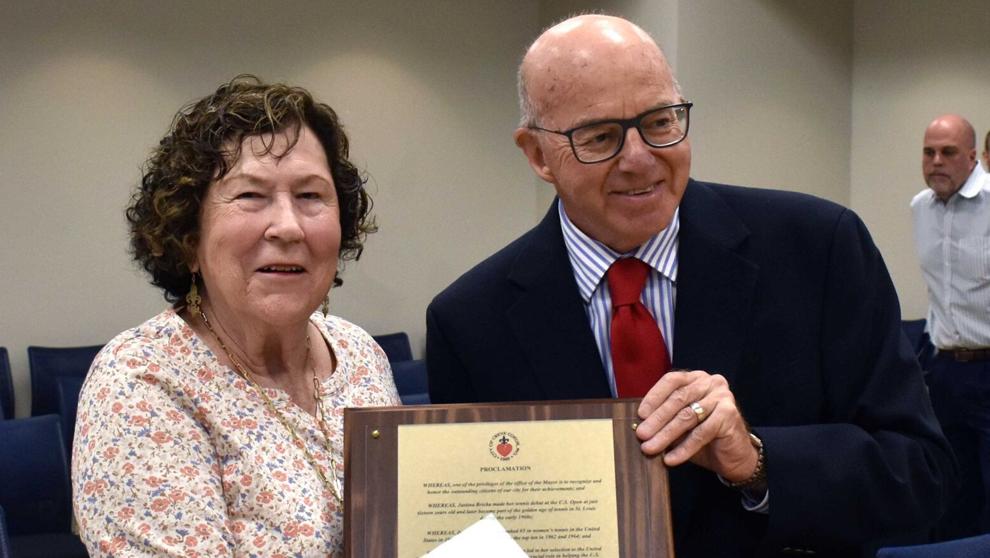
Creve Coeur Mayor Robert Hoffman recognized resident Justina Bricka for her life-long achievements in tennis at the city council meeting Sept. 26. (Source: City of Creve Coeur)


A special proclamation was the sweetest way to kick off the Sept. 26 Creve Coeur Council Meeting. That’s especially true because it honored long-time Creve Coeur citizen Justina Bricka, born on Valentine’s Day in 1943.

Mayor Robert Hoffman stepped to the podium with Bricka to deliver a seven-paragraph declaration of her incredible tennis feats as a player, referee and instructor. Most prominent of the items mentioned were Bricka’s No. 5 U.S. women’s ranking in 1961, her major role in helping secure a national Wightman Cup Team title and a myriad of top doubles tennis finishes.

He noted that Bricka was inducted into the St. Louis Sports Hall of Fame on Thursday,  Sept. 14, an honor she acknowledged in her acceptance speech at the Creve Coeur board meeting. The Fall 2023 Hall of Fame class also featured Frank Viverito, Jimmy Collins, Curtis Francois, Rick Gorzynski, John Ulett, Jason Motte, Chris Pronger, Carolyn Kindle, Rex Sinquefield and David Lee.

“I want to thank the Creve Coeur City Council for this recognition. I’ve enjoyed living here in Creve Coeur for some 27 years. So, this means a great deal to me,” Bricka said. “Not only is it special to be honored and recognized for my career in tennis, but it’s very special to be inducted alongside many great athletes across all of our great sports. St. Louis is truly the greatest sports town in America, and to be inducted alongside these many athletes is truly humbling.”

Again, I want to thank you all for this special recognition this evening. Thanks!”

Bricka told West Newsmagazine that when she received a letter from Creve Coeur City Clerk Kellie Henke asking if she and any of her family would be interested in attending, she responded immediately. 

“I called back right away and said I am thrilled, appreciate the honor and will definitely be there.” 

She was accompanied by her son, Lou Horwitz, a criminal defense attorney in St. Peters.

As for her Hall of Fame induction, she said, “That was fabulous! It was unbelievable! I turned 80 this year. So, you don’t expect it to still happen when you’re that old. But also, St. Louis is a great place to live, to grow up and to grow old, and it’s also the best sports city in the United States.”

Bricka made it clear she was referring to all sports, not just the nation’s most well-known team sports.  Referencing local author Ed Wheatley’s book “St. Louis Sports Memories: Forgotten Teams and Moments from America’s Best Sports Town,” Brick noted that 13 pages are devoted to tennis and much is said about the local prominence of bowling. In fact, Bricka is featured prominently in Wheatley’s book along with Carol Hanks Aucamp and Mary-Ann Eisel Beattie, who were collectively known as the “Golden Girls of Tennis,” when they played in the 1960s.  

“These three women … [did some] outstanding stuff. They played at Wimbledon, the U.S. Open, the French Open, the Australian Open,” Wheatley told St. Louis Public Radio’s Emily Woodbury in a December 2022 interview.  

In her own recollection of St. Louis sports, Bricka said she has great memories of watching Wrestling at the Chase and noted the fact that corkball was invented here with its popularity going back to the 1890s.

Bricka was in the very first class of inductees into the U.S. Tennis Association’s St. Louis Hall of Fame back in 1990. But she said she had no idea she would develop such prowess in tennis as a mere 9- or 10-year-old left-hander.

“When I went to grade school at Flynn Park in U.City, I also went to camp. My mom dropped me off there and it was just swimming and tennis. After the first day of swimming, I hated it for things like just putting my face underwater. So I started getting dropped off just for tennis. There were handball courts in Heman Park, and when I got a little better, I could hit against the wall.”

She said the clinic, run by Earl Buchholz Sr., was really fun.

It didn’t take long for pure enjoyment to translate into exceptional performances. At the tender age of 16, Bricka won the deciding match for the U.S. by besting Britain’s Angela Mortimer. What was most thrilling and shocking about that match was that Mortimer had recently become the Wimbledon champion.

Her most prominent singles victory occurred the very same year when, at the 1959 U.S. Nationals, Bricka fought off three first-round match points to defeat the long-time, world-famous Bille Jean Moffitt King. That controversial result is worth reading about on several tennis sites.

Other highlights include winning the national clay court doubles title with Hanks Aucamp, who is also in the local sports hall of fame, and winning the Irish doubles with Eisel Beattie. She also combined with Margaret Smith Court to win the Swiss Open and finish runner-up in the French Open.

Twice Bricka and mixed doubles teammate Frank Froehling reached the semifinals at Wimbledon. She won the mixed doubles with Gene Scott at the Merion Cricket Club.

Her tennis career would have lasted much longer, but the rewards back then paled in comparison to those of today.

“When you went to a tournament like the Southern Circuit, you had to find someone with a car and you went from one place to another. When you were at the tournament, people affiliated with the tennis club or with tennis in that area would house the players. You’d stay at their homes and get breakfast and dinner there, and you were on your own for lunch. Also, there was no money back then. If you won, all you got was a trophy. They weren’t allowed to give money as an amateur sport.”

Shortly after retirement, Bricka married Dick Horwitz and later became a referee for the Women’s Pro Tour.

“The WTA, Women’s Tennis Association, asked me to be the tournament referee for the Avon Tour, which was mostly called the Virginia Slims Tour. It was the only women’s tour in the winter. It was held in about 10 different cities, then the finals were in Madison Square Garden. That was very exciting because I had never been a ref,” Bricka said. “I was getting to do all the things in the sport that I really loved.”

She subsequently accepted a job at Triple A in Forest Park as the first female head tennis professional in St. Louis.

“I had played at Triple A most of my life, so I guess it was natural that I fell into getting the job there. I was also teaching clinics in area schools,” she said. “But at Triple A, there was no money in it. How would you tell that to your parents? That’s why I started teaching. 

“If you were teaching, you had an income. I knew I would always have a job teaching. I also taught some at John Burroughs. That was years ago!”

After her sons, Lou and Joe, were born two years apart, Justina was offered work at the brand-new Frontenac Racquet Club. That’s where she was for 30 years, including stints as manager and owner.

Unfortunately, the last time she played tennis was some 15 years ago, having suffered through “a hip replacement, torn rotator cuff, issues with her left hand, spinal stenosis and really bad arthritis.”

Still, detailed memories of tennis highlights from the past 70 years resonate through her mind and heart.


Wednesday, September 6, 2023

Ballwin alderman encourages: 'All of us can make the world a better place'

 (From late August 2023 issue of West Newsmagazine)


A saying long attributed to John F. Kennedy is featured on a poster hanging on the office wall of Ballwin alderman Mark Stallmann (District 2). It states: “One man can make a difference. Every man must try.”

The message has perfectly described Stallmann’s fervor for aiding those with autism.

Mark and his wife, Karen, met as students at UMSL and were married in 1985. Their son, Matthew, was born in 1989 and later diagnosed with non-verbal autism.

Ballwin alderman Mark Stallmann with his son, Matt, and wife, Karen. (Family photo) 

According to the Centers for Disease Control and Prevention (CDC), roughly 1 in 36 American children are on the autism spectrum. The CDC defines autism spectrum disorder (ASD) as a developmental disability caused by differences in the brain. People with ASD often have problems with social communication and interaction, and restricted or repetitive behaviors or interests. People with ASD may also have different ways of learning, moving, or paying attention.

“It’s something that wasn’t understood for a really long time,” Stallmann said. “At first, they thought Matt was just delayed, then mentally retarded. Finally, when he was about 10, he was diagnosed with autism.”

The couple subsequently headed various programs on the topic. It was also around that time that they became Ballwin residents and Matthew entered into the Rockwood School District.

“Matthew started out at Kehr’s Mill Elementary ... before continuing onto Crestview Middle School and Marquette. It wasn’t going very well,” Stallmann said.

As an alternative to full-time public education, the family was directed to an independent school, called Giant Steps of St. Louis, for children and young adults with autism.

“They were great, and I’ve been on that Board of Directors for about the last 10 years,” Stallmann said. 

When Matt started at Giant Steps, it was located in part of the old Westminster Christian Academy campus, after its purchase of the West County Tech building. Giant Steps is now located in Maplewood – ironically, in the former Concordia Lutheran grade school building where Stallmann once attended. 

When Matt aged out of education the Stallmanns sought another type of program. They were directed to the Midwest Autism Program at the Center for Head Injury Services, now called Center for Specialized Services. The center began as a recovery program for individuals with traumatic brain injuries – some from birth and others from accidents.

Matt has been attending the center since age 21. Stallmann now serves on its Board of Directors. 

“They train people for the job market with assisted employment,” Stallmann said, noting that job coaches help center participants obtain and maintain jobs. “Prior to the pandemic, they would arrange for Matt to go to the food bank, he’d volunteer at the YMCA and stock the copying machines at Maryville University.”

In addition to job training and coaching, the center offers a full spectrum of services to help people with brain injuries, autism, neurological disabilities, strokes, visual impairment and blindness, developmental and learning disabilities, mental illness, limited mobility and physical limitations. Those programs include day (SELF) services, community support services, therapy and counseling services, adaptive equipment services, employment and vocational services and social enterprises, which includes the Destination Desserts food truck and Wags in a Bag, a dog treat bakery. 

Destination Desserts travels the metro area to businesses, parks and events offering a selection of gourmet cookies, cupcakes and other desserts. Wags in a Bag is a regular vendor at fairs and other events where furry friends are welcome and sells its treats directly and through specialty pet shops.

“Matthew understands pretty much anything you say to him. He just can’t respond verbally. He’ll make noises, laugh or cry and make other sounds, but he can’t speak,” Stallmann said. “He uses an app called ‘Prologue to Go’ on his iPad; then he can ask, ‘Can we go to the mall or Dairy Queen?’ There are also buttons to push like ‘Can I have something to eat or drink?’

“Technology has come a long way. When we started, we had a talking board, which was basically a screen with pictures, and he’d point to something he wanted. Then, we went to basically a touch screen computer where you’d push one button and it would say what he wanted. From there, we went to a more advanced computer like what his iPad does where it can be programmed for more specific choices. He can type some words and sentences and if you hold his elbow, he can spell out stuff he wants.”

Matthew can’t drive and will never live independently. Stallmann said Matt will have to be in some kind of facility or group home and, although Matt’s been on Medicaid since age 18, he said they faced bureaucratic issues enabling him to continue that process. Stallmann’s political relationships helped but for most people he said acquiring the care they need is a major struggle.

Stallmann is quick to give credit where credit is due. 

“My wife does a fabulous job with Matt,” he said. “Because I’m gone a lot, she always takes care of him and advocates for him.”

An advocate himself, Stallmann  was appointed by Gov. Mel Carnahan to the public review committee for the Special School District (SSD).

“It was that group that came up with the current structure of the SSD,” Stallmann explained. “It’s now run by the school districts as the governing council instead of unions like the NEA (National Education Association). School districts elect people and the governing council selects the school board. They’re not an elected body any longer. It has worked out well. I was actually treasurer of the campaign to get that passed on the ballot, and was also active for SSD’s tax campaign.”

Stallmann’s desire to champion for those whose lives are challenged by disabilities was likely inspired by his dad, Reinhold Stallmann, who relied on a wheelchair as the result of polio.

Reinhold became ill while engaged to Stallmann’s mother. His parents were married the day Reinhold left the hospital. A Lutheran minister, Reinhold went on to graduate from Concordia Seminary. He spent his career at the Concordia Publishing House as a writer, proofreader and editor.

“My father was involved in community, and I learned from him that you have to make a difference. I firmly believe all of us can make the world a better place; especially for kids and adults with autism,” Stallmann said. 

To join in helping children and adults with autism, consider joining the Center for Specialized Services at  Old Hickory Golf Club in St. Peters for its 20th Annual Gray Matters Charity Golf Tournament on Sept. 28. Registration is due by Sept. 14 and can be made online at cssstl.org. 


Sunday, August 27, 2023

Ballwin woman honored for life-saving actions

 (This story with 2 of my 6 photos appeared very recently in  print and online for West Newsmagazine)


The Ballwin Board of Aldermen kicked off its Aug. 14 meeting with a trifecta of honors for resident Debra Belobraydich.

While walking her dog, Belobraydich was approached by a woman along Kehrs Mill Trail, who asked if she could help at a nearby subdivision pool.

“Honestly, I didn’t think it was an emergency at first because she just asked if I could help at the pool,” Belobraydich recalled. “Then, when she said someone was drowning, the first thing I did was just run straight to the pool. It kind of all unfolded from there. I kind of went into an adrenaline mode of whatever I needed to do to help with the situation.”

The person drowning was an 11-year-old girl who had sunk to the pool’s bottom. Belobraydich acted quickly to save her life.

At the meeting, she noted that the incident occurred at a swim-on-your-own subdivision pool with ‘No Lifeguard on Duty’ signs.


According to Metro West FPD Capt. Matt Coppin, Belobraydich made several perfect spur-of-the-moment decisions in the life-saving scenario.

“There were other people in the pool, but nobody was feeling comfortable to go get the girl at the bottom of the pool,” Coppin said. “Debra saw what needed to be done and didn’t hesitate. She jumped in and got the girl out of the pool. Not only that, (but) what impresses me the most was her ability to think through the logistics of what needed to happen next. She checked to make sure 911 was on the way. She made sure the ambulance went to the pool. She organized kids to be ready with the words, ‘Don’t let the ambulance pass you! Stand in the street to let them know we are here.’

“She also rolled the girl on her side to make sure the water came out from her mouth. She knew what to do to organize the people that were there. For somebody who is untrained, that’s incredible! Without a doubt, Debra is the reason that girl is alive today. There’s no question about that.”

Ballwin Police Capt. Jon Bergfeld was in total agreement with Coppin’s assessment.

“You hear all the time how citizens stand by and expect somebody else to take action, and a tragedy occurred because no one would do that,” Bergfeld said. “As Matt Coppin said, sometimes you just need a leader in those situations, and it’s the unknown heroes who will step forward and say, ‘Go wait for the ambulance or fire truck to show up.’” 

While presenting Belobraydich with her second plaque of the evening, Bergfeld added, “You are a role model to our citizens here. Because of your willingness to act, a positive outcome occurred here. On behalf of the Ballwin Police Department, we’d like to award you the Citizens Service Citation.”

It was Mayor Tim Pogue’s honor to follow up with a proclamation from the city, after which laughter filled the room when it was questioned as to whether or not the Belobraydich family had enough wall space to sport all those honors.


Coppin noted that, within a few days, the young girl walked out of the hospital in good health. He stressed that, contrary to popular opinion, it’s rarely apparent or obvious to bystanders when someone is drowning.

He said drownings are silent events despite movies showing a person splashing around and yelling for help. When somebody is drowning, he said, they’re doing everything they can just to keep their head above water. So, they don’t have extra energy to splash around and yell for help.

“As a fire department, we teach CPR, ‘Stop the Bleed’ and other safety courses,” Coppin said. “Also, everyone who graduates high school now has to have a CPR class. Metro West, Red Cross and American Heart offer them, too. There are lots of options to get that education. But those courses don’t work unless somebody takes the initiative to act. A lot of times, people think, ‘I’m not trained, I don’t know what I can do.’ But if it’s a bad situation, you’re not going to make it worse. Maybe you’ll act and make it better.”

Belobraydich said the experience was overwhelming.

“You never expect to go through a situation like that and it’s nothing you plan for. I feel like God was truly with me that day, and I’m so blessed that she’s OK. It’s nice to have a community that supports you like this but nobody really has to go and honor or recognize me.”


Thursday, August 10, 2023

Tony Gwynn: A Gem On and Off the Diamond

(Here's an article I produced on one of my favorite athletes of all time for the May 1988 edition of The Sports Journal of Calgary, Alberta. The story is just four seasons into the lengthy, 20-season Hall of Fame career of the man who barely made it to age 54.)


                                                                      (Breitbart photo)

Those who claim that all high-salaried players are self-serving primadonnas don't know Tony Gwynn.  But that unfamiliarity of personality should not be surprising considering how few people are even aware of Gwynn's on-the-field talents.

Gwynn's accomplishments are staggering! In his four years with the San Diego Padres, the 27-year-old rightfielder has compiled a .335 career batting average, including a pair of batting titles. His .370 batting mark last year was the National League's best since Stan Musial's .378 in 1948.

"He's amazing at the plate," Padres infielder Mike Flannery said. "He does everything right.  He'll get a hit on an incredible pitch; maybe one theat's busted him inside, and all of us on the bench will look at it and shake our heads.  It happens all the time."

But there's far more to Gwynn's abilities than making contact at the plate. He also earned his second straight Gold Glove and swiped 56 bases last year, second only to the Cardinals' Vince Coleman. Gwynn's seen All Star Game action all four seasons as well.

"If I had nine Tony Gwynn's suiting up every day, I wouldn't have to manage them a minute," said Padres skipper Larry Bowa. "His work ethic and every day contribution is just incredible!"

In addition to all of Gwynn's baseball accomplishments, which also included a trip to the World Series in his rookie season, Gwynn is the ultimate role model for other young players.

"I've never in my life seen anybody with Tony's work habits and dedication--and his desire to improve," teammate John Kruk said. "It's infectious!  You can't help but want to adopt his habits.  He's inspiring!"

Gwynn's list of good deeds involving the fans and the media probably even surpasses his baseball statistics.

When a couple players turned down an interview at Yuma (Arizona) Junior High School, Gwynn accepted and turned a 10-minute session into a comical half hour.  In fact, Gwynn's the man that Padres assistant public relations director Mike Swanson looks to when other teammates are unavailable to the press. 

Gwynn's love for children has led to personal sacrifices like missing a late night meal in St. Louis to satisfy dozens of autograph seekers in the streets after complaining to San Diego pitcher Greg Booker of being starved. Gwynn also suffered emotional pain while visiting a home for abused children in Las Vegas.

"That's just me," Gwynn said.  "I can't stand when people think baseball players are better than anybody else. I realize how lucky I am.  But I was raised to believe that you treat people as you'd want to be treated. That's all I do.  That's easy."