Copyright 2013...Jeff Greenberg...All Rights Reserved
No writings or any other items on this blog may be used or reproduced in any form without the author's written permission or consent.

Saturday, August 27, 2022

Ellisville council considers further legislation related to bees

 (Here is a late July 2022West Newsmagazine article that generated so much attention both online and in print, that is led to a follow up article just one month later!)


Honeybees and other pollinators are declining in numbers.

Exactly one month after the start of National Pollinator Week (June 20-26) Ellisville City Council member Vince McGrath (District 1) offered a vastly different side of bees during the council's July 20 work session.

McGrath said he received a rather detailed complaint in one of his district’s neighborhoods about residents with a pool getting stung by bees. Not knowing exactly how to handle the negative buzz, McGrath admitted he felt obligated to delve more deeply into the subject. So, he did a good deal of research.

“It turns out the bees really like chlorinated water,” McGrath said.

He added that “beekeeper etiquette" would be for the keepers to talk to their neighbors. Then, he offered more information about bees, such as "the average hive has about 30,000 bees in it."

"There are some that forage for food; others forage for water," McGrath noted. "From what I’ve read, a hive of bees can go through several liters of water a day. Of course, with a very close water source, this can be a problem.”

McGrath said he constantly has bees hanging around his own bird bath. He added that when he sprays them with water, they get aggravated, but he’s never been stung. However, he admitted he also has never gone swimming with them.

“One of the big concerns is that they don’t know when somebody comes to their pool if they are allergic to bees,” McGrath said of the residents who had reached out to him.

He requested that the council to look into legislation that would amend its current beekeeping regulations. His proposed changes are:

• Require beekeepers to provide a water source for the hives/bees.

• If a property measures less than 1/3 of an acre, the maximum number of hives allowed would be three.

• If the beekeeper's property is near a pedestrian walkway, a 6-foot fence must be installed around the hives.

• If property owners want to have bee hives near a neighbor with a pool, the beekeepers must discuss it with neighbor before installation of the hives.

Regarding point three, McGrath said that if bees have to fly over a structure that tall (a 6-foot fence), they would normally be well over the height of most humans. 

Mayor Mike Roemerman said that the first two points are easily doable. While he didn’t address the third suggestion, he did say that “number four is going to be very difficult to put into language that’s enforceable.”

The council and City Attorney Brian Malone will work on legislation with amendments to be presented at the Aug. 17 council meeting.

Ellisville quickly backtracks on suggested beekeeper restrictions


Back on July 20, the Ellisville City Council tossed around ideas to try and prevent any of its citizens from suffering bee stings while enjoying private swimming pools.

The first potential restriction mentioned would have required beekeepers to provide a water source for the hives/bees. If a property was less than 1/3-acre, the maximum number of hives would be restricted to three. If the hive location was near a pedestrian walkway, a 6-foot fence would have had to be installed around the hives. In addition, if the property owners wanted to have bee hives near a neighbor with a pool, the beekeepers would have had to discuss it with the neighbor before installation of the hives. The idea of requiring beekeepers to hold special permits was also suggested.

Within a week, those ideas were displayed both online and in print.

The buzz spread quickly and several members of the local beekeeping community swarmed the Aug. 17 council meeting. Seven offered their feedback during the initial public comments section of the meeting. They noted the rapid decline of honey bees over the past few decades and some mentioned the use of insecticides, pesticides, herbicides and fungicides as a rapid means to that decline.

Some spoke to the council’s attempt to control nature. 

“Honeybees are very busy minding their own business, and they’re just trying to take care of their families,” Mary McCord noted. 

Lisa Kosyan added, “It’s a matter of what we can control and what we can’t control. We can’t control where they fly and where they go.”

Kevin Marrott suggested that the onus is on pool owners to keep the bees out of their pools.

Jane Sueme, owner/operator of Isabee’s Beekeeping Supplies, explained the need for bees to be around major water sources at various times of the year. She said that while people complain about bees being near their pools or hummingbird feeders, it’s just for a short period of time and for the bee’s survival. She added that even in managed hives, bees are wild insects and cannot control their need for water sources.

“They need to be around water sources around early March and again when the temperature gets well above 90 degrees,” Sueme said. “When it gets really hot for a day or two they can handle that with their independent resources. But when it’s 100 degrees, like we had this summer for days on end, they have to store somewhere between half a gallon and a gallon of water per day per hive.”

Since Sueme’s Fenton location is the only retail establishment in the area to serve the area’s beekeeping community, she said they field a lot of phone calls from the general public and help them understand the behavior of honeybees.

Council member Dan Duffy (District 3) thanked those “who came out to support the bees.”

“Their survival depends on the actions people like us take,” Duffy said. He noted that the city has taken a number of measures that are “really at the forefront of actions to help our insects,” which have increased the bee population within the city. Those actions include using more native plants within the city and planting a large native grass area by the Bluebird Park amphitheater. Ellisville even hired a public works employee to care for those areas, he said. 

“I also don’t agree with the idea of giving pool owners preferential treatment,” Duffy said. With that in mind, he made a motion to strike down all beekeeping regulations regarding swimming pool owners and also extra necessary permits.

Meanwhile, Council Member Vince McGrath (District 1) who brought the issue to light in July said he didn’t intend for any beekeepers to be hurt by what was discussed at that time. One of his major intents was limiting the number of hives per lot, he said.

The result of all the comments was that every single previous restriction was dropped and only one was added: Hives must be at least 10 feet from a neighbor’s property line.

Mayor Mike Roemerman said the “extremely amended” bill (No. 3756) was now even less restrictive than even before the previous council meeting. It passed unanimously to become Ordinance 3523.


Tuesday, July 26, 2022

Tappmeyer Homestead to be all dolled up for August event

 (From today's West Newsmagazine online edition)

Dolls, carved from soapstone and other organic materials, are thought to be among the world's oldest toys, dating back to the Paleolithic Era. But its a far more recent collection that will be  featured at the Tappmeyer Homestead in Creve Coeur’s Millennium Park this month.

American Girl dolls, which became the rage a quarter century ago, will be on display from noon to 4 p.m. on Aug. 14 and Aug. 28. Admission to the exhibit is free, but donations are encouraged. 

At 2 p.m. on Aug. 14, the story of one of those dolls, Nanea Mitchell, will be brought to life over Zoom by the woman who inspired it. Registration is required for this event via email at TappmeyerHomestead@gmail.com, or through the link online at TappmeyerHomestead.org


(Photo by Caren Libby, Tappmeyer Homestead)

Kansas City resident Dorinda Makanaonalani Nicholson will share what it was like to be a 6-year-old girl residing in Pearl Harbor on Dec. 7, 1941, when Japan bombed the harbor and the U.S. officially entered World War II.

“We moved to Pearl Harbor (from Honolulu) in early 1941,” Nicholson explained. “My mom got a job with Pan American World Airways. At that time, that was the only way you flew to the islands – on sea clippers – and you landed in Pearl Harbor. We rented a house there, so mom could walk to work.  Little did we know that by the end of the year, we would be right there at Ground Zero of where the attack was going to happen. 

“I remember standing in the front yard with my dad on the morning of the 7th. There was so much noise and we could feel our house shake and hear the explosions, and airplanes (which she later learned were torpedo bombers) were flying right over our house.”


Nicholson also recalled how her family hid in their car in the sugar cane fields after President Franklin D. Roosevelt told Gov. Joseph Poindexter that Pearl Harbor was under martial (military) law. She said her family knew what was happening because they were glued to their car radio.

The military police refused to let any area citizens return home until the area was cleared, so Nicholson and mom, dad, little brother and dog were taken to live at nearby Sugar Plantation Village. They were fingerprinted and had to carry gas masks and I.D. card at all times, she said. Air raid drills were common and phones were off limits except for emergency use. Schools were closed until February and there was large-scale rationing. 

Sharing the stories and history of Pearl Harbor, WWII and Hawaii have become part of Nicholson's life work. She especially enjoys speaking in classrooms and sharing her story with children. In fact, she wrote a book for them: "Pearl Harbor Child: A Child's View of Pearl Harbor from Attack to Peace." It is available on her website (pearlharborchild.com) along with an accompanying coloring book and other titles penned by Nicholson and her husband, Larry. 

At age 81, Nicholson was asked by American Girl to serve on the advisory panel for Nanea, whose motto is "When fear strikes, let the aloha spirit be your guide." 

"Because I went through the bombing and lived in the middle of the harbor and went through all of it at about the same age as Nanea, they asked me to be an advisor and I was thrilled," Nicholson told the Today Show at the time of the doll's release in 2017. 


                                             (Nanea Mitchell, American Girl)

How Nicholson came to be invited to the Tappmeyer House is another interesting story.

“I serve on the board of Missouri Humanities Council. Dorinda Nicholson was also a board member," explained Laura Dierberg Ayers, who is on the board of the Tappmeyer House Foundation. 

"I knew that she was originally from Hawaii and that she witnessed Pearl Harbor. One time, she mentioned that the Pleasant Company, the original maker of the American Girl doll, was interviewing her for the inspiration of their Hawaiian featured American Girl doll named Nanea.”

On Aug. 15, an American Girl evening camp, sponsored by the Creve Coeur Parks Department and led by Bellerive Elementary teacher Ashley Jelovic, will also highlight Hawaii and the story of Nanea.  

Two previous evening camps featuring other American Girl dolls took place in June and July. 

"It’s a wonderful setting for this historic doll collection," Ayers said. From personal history, she should know. "Tappmeyer was my family’s homestead. My mother was the last generation to be raised at the house, but my parents and I lived off Mason Road after my parents got married. I spent a significant amount of time almost every week at my grandparents’ house."

As a Tappmeyer House Foundation board member, Ayers is involved in its programs and noted that the Spirit of St. Louis Doll Collectors Club also will have members' dolls on display at the home on Aug. 14. Additionally, members of the community will have their American Girl dolls and some of their homemade accessories on display. 


Wednesday, May 25, 2022

Philip Woodmore’s music destiny keeps evolving

 (Fun in-person interview and ensuing article for West Newsmagazine)

Countless people have no idea what their profession may include until they are well into their teen years and beyond.  Others are never really sure. That was not the case for current Ballwin resident Dr. Philip A. Woodmore.

“My mother (Alma) said she knew I would be a music influencer or at least a music lover,” Woodmore said. “She knew this because even in the womb I would only be awake when choirs were singing or music was playing. As a toddler, I would crawl to the piano, pull myself up and bang on the keys. So, I took piano lessons at the age of 5.”

The piano remained Woodmore’s instrument through Ellisville and Kehr’s Mill elementary schools and Crestview Middle. Prior to his 2000 graduation from Marquette High, he sang in choirs and handled piano accompaniment for all musicals under theater teacher Judi Greene. Woodmore even helped direct music there for about 13 years until Greene retired.

Woodmore earned a marketing degree from Saint Louis University, but found that he was bored in that sphere from the outset. As a sophomore, he auditioned for the university’s Music School and double majored in marketing and music. As an undergraduate in 2005, he was offered a teaching job. In the years that followed he has taught choir in Ferguson and Berkeley middle schools, and started his master’s in music education at Webster University.

“I feel like I stumbled into teaching. Judi always told me I’d be a teacher and I’d laugh at her.  But when I was offered a teaching job, it was like, ‘OK, I’ll try this out, and it’s a steady paycheck.’ I fell in love with education in the first month. Middle school became my thing. It was just the age I connected with as an educator.”

Woodmore noted psychological changes kids go through at this age as beginning performers with no control over what’s happening to their voices.  He also helped in other aspects of adolescence with an emphasis on teaching his students to be good citizens. 

He proudly revived those two fledgling middle school programs through a battle of the choirs that drew 500 people to the community event. 

Next was a job at Crestview Middle starting in 2006. He built that music program from 225 kids to 350. He was also involved with Stephanie Riven at COCA (Center of Creative Arts), helping the theater music program and later was coordinator of their voice program, wrote the curriculum for their music program and directed their shows. It turned into a second full-time job.


Philip A. Woodmore directing the 'Antigone in Ferguson' mass choir during a performance in Brooklyn, NY...Gregg Richards photo

“In August 2016, I got a phone call from a gentleman in New York named Bryan Doerries. He wanted me to put together a project in St. Louis to help us heal after the rioting and everything following the murder of Michael Brown in 2014.  He wanted me to get a choir together to perform this project he called ‘Antigone in Ferguson,’ a likeness of ‘Antigone’ from Sophocles in Greek mythology. His concept was to bring it to a space, do it in art form, then have a community conversation. He wanted the choir that was doing that to be stakeholders in the community, including police officers because there was a lot of tension between police and the community.”

Doerries contacted Woodmore because he had directed the St. Louis Metropolitan Police Department Choir, the performing group of COCA, a voice studio and a similar work at the church of his father, pastor Willie Woodmore.

When Woodmore was told the show was going to be on Sept. 17, he thought it was the following year; not just 45 days later. But the shortened schedule did not deter him.

Woodmore became composer, original music director and arranger for the show. He was excited for it to be performed in St. Louis but never dreamed of the life it would take on. 

After premiering here, he was asked to take it on a two-year national tour plus a performance in Athens, Greece. The show then got picked up Off Broadway in New York for two years. Unfortunately, he was forced to pull out of teaching in 2017 to manage the show full-time. 

Woodmore spent roughly half the year in New York.  The show made a run at the Kennedy Center in D.C. then moved to Baltimore. The company was set to leave for Virginia when the pandemic hit and all ensuing performances were canceled. 

He went from a large body of work with a nice income to no work and no income. He wasn’t in a position to collect unemployment, and had no work engagements. He started soul searching, and began an online voice studio. He recruited 38 students in about the first week.

“My big savior was a phone call from Rebecca Messbarger, a professor at Wash U. She wanted to put together a memorial service for the city of St. Louis for everybody who has died from COVID. She studies pandemics and said one of the major issues why we can’t move on as a society is we don’t pause to mourn. She was adamant about this, raised all this money, brought me on the team as the artistic director; and I wrote all the music for the event in St. Louis this past October.”

The memorial included 1,800 lanterns in the Grand Basin in Forest Park to honor over 4,000 people who died from COVID.  A recent lantern lighting ceremony was held there on April 23.  

Woodmore said getting involved in that project and working on something that impacts the community revived his creative energies.

He has written several plays, including “The Drum Major Instinct” (about Dr. Martin Luther King Jr.), “Frederick Douglass,” and a children’s play titled “Growing Pains,” performed as a workshop. He is currently writing “Team M” and hoping for a 2023 St. Louis premiere. He also lectures around the country on how music brings people together like a universal language and creates a safe space. 

Another Woodmore project is a script for a production tied to mental health, particularly in the black community where the subject isn’t talked about as much. 

Through it all, there’s one thing nearly all of Woodmore’s projects have in common: passion.

“As a child, I didn’t know what I liked about music. It was just in my fibers. In high school, I thought singing was just a pastime. To be able to build a career from music and offer that to a community in a thoughtful and powerful way is amazing.  

“Music is my passion. It’s what I was doing when I was 5 and what I’m still doing at age 40.”

Thursday, May 19, 2022

Ballwin seeks citizen input on mosquito control measures

 (Appeared in mid-May 2022 West Newsmagazine)

When it was time to deliver his staff report at the May 9 Ballwin Board of Aldermen meeting, Public Works Director Jim Link began by uttering one word in a most menacing tone: "Mosquitoes!"

Link’s recommendation was to enlist St. Louis County to aid in Ballwin mosquito hunting. Their role would be truck-mounted fogging in a program known as "adulticiding." Link said the county would not be performing routine spraying, but would do so based on the results of trapping and testing adult mosquitoes throughout Ballwin for potential major diseases.

St. Louis County Vector Control furnished Ballwin with an eight-page document detailing where they would handle the adulticiding. The county will put traps in various places including creeks, areas of standing water, detention basins, drainage, culverts, ruts and ditches.


(Source: Adobe Stock)

Link said that in the past, Ballwin sprayed for mosquitoes themselves, taking care of the "larvaciding" portion of mosquito control by destroying larva. Then in 2010-2013, the city contracted out to St. Louis County to do larviciding and adulticiding.

Although Ballwin has done well handling the mosquito issue on its own, Link cited worker shortages as a reason to continue to seek the county's help. Ballwin's 2022 budget provides for 34 full-time employees, but public works department currently has just 26 full-time employees, plus three full- and one part-time seasonal employees.

Link also made it clear that he doesn’t want the quality of maintaining Ballwin streets to be adversely affected by too many staff hours dedicated to mosquito eradication.

After a lengthy discussion, the board rejected Link’s recommendation by a 5-2 margin, at least in the short-term. Before making a final decision on the matter at its May 23 meeting, the board is hoping to receive citizen input on the subject.

“I remember when we tried this a couple years ago with St. Louis County," Mayor Tim Pogue said. "I think we did it a couple years, and we received quite a few complaints, so we ended up going back to what we had been doing ourselves. I appreciate you looking outside the box but I still would have concerns going back to what it was; especially, if they’re only going on their trap results. It’s my understanding they will not go just on complaint.”

Alderman Michael Finley (Ward 1) followed Pogue. 

“I did some research," Finley said. "Six or seven years ago, I made contact with an entomologist at one of the universities in Illinois. I asked him his thoughts on this whole thing, and he said it depends on your perception, or what you want your citizens to perceive. Do you want your citizens to perceive some active program? If that’s what you want and you want to put the truck out there, that’ll be OK. You’ll kill some of them. If you don’t want to do it, that’s fine too.  he net effect is not really that great.”

He added that he has wondered his whole life if fogging really works since, even with that, he and family members still get bit. 

Still, Finley was one of just two who voted in favor of St. Louis County immediately helping out. He mentioned research he had found from Mississippi State University regarding a five-step approach of education, surveillance and sampling, source reduction, larvicide and adulticide. He said he believed that St. Louis County is acting correctly and doing its due diligence. He also noted that the county has a public health department, unlike Ballwin.

Alderman Frank Fleming (Ward 3) came to the same conclusion as Finley citing the department's employee shortage as a key factor.

However, he noted, "... most of the mosquitoes are behind your house, in the common ground, in creeks, whatever. I don’t know how much it (spraying) gets back there where they are the big problem; (how much it) makes contact and wipes them out. But I would just go with the county; and if it gets bad enough, we always have our truck and our guy ... If people are complaining, we can always reconsider that.”

Finley mentioned most of Ballwin’s surrounding communities use St. Louis County, which currently charges some $95/hour for its program. He added that studies show spraying is still safe to people and it doesn’t affect pollinators like bees as long as spraying continues at night.  

However, in response to an inquiry from Finley, City Administrator Eric Sterman said Ellisville decided a couple years ago to stop doing adulticiding through the county. He said they don’t spray adult mosquitoes at all. They do larviciding by adding some tablets or pellets in standing water and other places of concern with a nominal amount of staff time involved.

In response to an inquiry from alderman David Siegel (Ward 4), Link said Ballwin already has someone ready to start spraying May 16 and usually has a supervisor and an operator do the task on a weekly basis.

Per questions from alderman Ross Bullington (Ward 4), Link added that the County already had its traps in place to monitor, and they relay that information to the city of Ballwin, which can start and stop any time with them. Meanwhile, Ballwin has been larviciding since Link has been there, and that will continue.

“There’s not a whole lot of things that St. Louis County does better than what we do right here in Ballwin,” alderman Mark Stallmann (Ward 2) said. “So I would be reluctant to do this.”

Finally, Pogue mentioned and Finley re-iterated that in the least, the May 9 meeting dialog could be an education process to remind citizens to remove any standing water from their property.


Sunday, May 1, 2022

Natural, man-made wonders to explore in Southern Illinois parks

 (This article appeared on April 29, 2022 in St. Louis Sprout & About.)

Imagine what it would have been like to have been among the first people to explore some of the natural wonders of the great outdoors. The southern half of Illinois certainly offers a wealth of scenic locations in which that feeling of awe still embraces its visitors. Mighty rivers meander around many of the sites, sculpting some truly magnificent rock formations to view and sometimes climb. Over time, these jewels of nature have been combined with a smattering of man-made structures, adding even more to the region’s fantasy settings.


                                         Meet dragons and knights on a visit to Boo Castle Park.     Photo by Jeffry Greenberg

Pere Marquette State Park
Precisely 350 years ago, French missionary Pere (Father) Jacques Marquette traversed the Illinois River near the state park that now bears his name. The site offers spectacular river views near its confluence with the Mississippi River. While the Great River Road town of Grafton provides boat launching ramps and boat tours, the area is also home to a wide array of other recreational activities, including bike and horse trails. The park also features more than a dozen miles of scenic trails for the beginner to the most experienced hiker. The best, lengthier trail is the combined 3.9-mile Hickory South, North, Fern Hollow and Goat Cliff Loop. Several shorter trails, plus the uphill Scenic Drive featuring Lover’s Leap and Eagle Roost Scenic Overlooks, all offer great views, particularly in the autumn. Pere Marquette Lodge & Conference Center serves breakfast, lunch and dinner, and hosts special events throughout the year. Pere Marquette State Park is located at 13112 Visitor Center Lane, Grafton, IL.

Giant City State Park
About 15 minutes south of SIU-Carbondale in Makanda, Ilinois, is an otherworldly escape for college students and kids of all ages. Giant City State Park is a rather compact fantasyland for all outdoor enthusiasts. The park borders beautiful kayaker-friendly Little Grassy Lake and houses six scenic trails with sandstone formations that are laden with wildflowers. The most popular trail is probably the Giant City Nature Trail, a one-mile moderate loop featuring huge sandstone bluffs. It’s fun for climbing, tunneling and also wiggling through Fat Man’s Squeeze. The .3-mile Devil’s Standtable Trail is named after its incredible giant mushroom-like pillar. Other easy but fun trails of a mile or less are the Stone Fort, Post Oak and Indian Creek Shelter Nature Trail. At 1.3 miles, the Trillium Trail is considered moderate. Grab a bite to eat at Giant City Lodge and take a moment to view the Civilian Conservation Corps (CCC) statue, which honors workers from 1933-1942. Giant City State Park is located at 235 Giant City Rd., Makanda, IL.

Boo Castle Park
Less than a 10-minute drive from Giant City State Park heading towards Carbondale is Boo Castle Park, a tribute to Jeremy "Boo" Rochman who was a fan of knights, wizards and dragons. The fantasy-inspired playground features climbing structures, knights, gargoyles, dragons, wizards, a sword collection and more whimsical play elements. Nearly every unfenced figure can be posed with and most can be climbed on (except for the castle ground items itself), but there are some restrictions for guests. Visit Boo Castle Park on Facebook in advance for more information about rules for visiting the park. Boo Castle Park is located at 31 Homewood Dr., Carbondale, IL. The park is open daily from sunrise to sunset (weather permitting).

Garden of the Gods Recreation/Wilderness Area
Located throughout the Shawnee National Forest, the Garden of the Gods is truly a godsend for photographers and outdoor enthusiasts. Both the close-up sandstone pillars and far-off panoramic views of towering rock formations, cliffs, woodlands and wilderness draw families from far and wide. The area’s most traversed hike is the ¼-mile Observation Trail, which is chock full of countless dramatic points of view in every direction, including Camel Rock, Mushroom Rock, and Devil’s Smoke Stack. Anvil Rock and Indian Point trails are worth exploring, as well. In all, there are some 5.5 miles of connecting trails in this one area alone. 

Fort Massac State Park
Overlooking a beautiful stretch of the Ohio River, Fort Massac became part of Illinois’ first state park back in Metropolis in 1908, but its history precedes that by more than a century. Although the fort’s replica remains closed at this time for repairs, there is still much to see. The site itself includes the Fort Massac Visitor Center, which features Native American artifacts and a video. The park is also home to an 18-hole disc golf course and a wide variety of outdoor recreational activities. Closer to the river is a statue of George Rogers Clark, who helped fight against a British takeover during the Revolutionary War. Few events rival the annual Fort Massac Encampment weekend, typically held in October, which includes food, children’s activities and historical reenactments. Fort Massac State Park is located at 1308 E. 5th St., Metropolis, IL. Visitor's tip: If you're in Metropolis, be sure to stop by the Super Museum for a photo with the 15-foot-tall “Man of Steel” statue on the building grounds, and watch for the annual Superman Celebration.

EDITOR'S NOTE: Scroll to the bottom of this article for Greenberg's additional photos of these natural and man-made wonders through  https://www.stlsprout.com/articles/places/item/8944-natural-man-made-wonders-to-explore-in-southern-illinois-parks?fbclid=IwAR1NgCguwUaUhIL9HIHbrwSVR3VzxjdYIzxzC9JQyW3lTVRaynsy7aV8Dbg


Saturday, April 9, 2022

Local nonprofit Friends of the Rainforest celebrates Earth Day all year long

 (Early April 2022 in West Newsmagazine)

Back in the late 1980s and into the ‘90s, West County elementary school teacher Rachel Crandell delved deeply into what became a life’s journey. She and her late husband, Dwight, frequently traveled to Costa Rica and ultimately founded the Monteverde Conservation League. They recruited several friends on their journeys and expanded that organization into the United States.

That was merely an embryonic step toward the birth of the Ballwin-based nonprofit Friends of the Rainforest.

“Our founder, Rachel, started this organization as her own advocacy as a school teacher,” Executive Director Sophie Arp said. “She was bringing all these rainforest ideas into her classrooms and saw how much it inspired kids to want to protect the rainforest. We had kind of an unofficial education program for a while, but it wasn’t until about 2015 when we developed an official education program. We hired an official education coordinator, and it kind of grew from there.”

Ballwin Elementary working with a Friends of the Rainforest bird beaks lesson pre-pandemic. (Provided)

Today, Friends of the Rainforest offers a varied curriculum and hands-on classroom lessons. The pandemic forced more take-home lessons and more online content in addition to more programs featuring hybrid lessons. 

Education and Outreach Coordinator Jamie Kisela had been going to schools and dropping off needed materials; then, giving lessons virtually or offering them to the teachers. Now, many schools have returned to offering these classes in person. Generally, the lessons are for students in grades kindergarten through grade 5. 

All lessons are completely free and Friends of the Rainforest works with public and private schools, home-school groups, church groups – basically any group of kids that wants to learn about the rainforest. Recently, the nonprofit was accepted into the STEM-STL program. Their long-term goal is finding ways to branch out all across the St. Louis area.

                                           Students completing a Friends of the Rainforest lesson. (Provided) 

Groups can sign up under the education tab, at friendsoftherainforest.org or by contacting Jamie@friendsoftherainforest.org

“Living in Missouri, the rainforest can feel very far away, but we’re ultimately trying to bridge that gap from middle America,” Arp explained. “Having hands-on activities helps in that way.

“One of the main messages we try to convey is just how interconnected everything is. We like to teach about the rainforest and the animals there, but kind of turn it back here in St. Louis.”

She said one question to be asked is, “What can we do here to help the animals there?”

“So, we have lessons about migratory birds. We can look at ruby-throated hummingbirds because those live in the rain forest as well,” Arp said. “Just focusing on all the different aspects of consciousness and about protecting the bees and what native plants can we plant here. Everything has an impact. Ultimately, our life on this planet depends on the rainforest.”

     Ballwin Elementary students after completing a Friends of the Rainforest lesson pre-pandemic. (Provided) 

In addition to its local educational programs, Friends of the Rainforest promotes a larger program that also was put on hold during the pandemic – its Eco-Tours. Recently, those tours resumed for schools, church groups and whoever else wants to visit the rainforest. The trips are organized through Natural Solutions, one of the nonprofit’s partner organizations in Costa Rica. Natural Solutions is run by co-owner and guide Jeff Norris.

Arp described Norris as very knowledgeable, willing to help in all the back-end planning and open to what the visitors want to see and do. Although the tours are customizable, one of the highlights of each trip is a visit to the recently protected Children’s Eternal Rainforest (el Bosque Eterno de los Niños). 

“You generally go for five days, a week or longer,” Arp said. “With school groups, we try to emphasize field and scientific studies that are already going on in the rainforest. Kids can come up with their own questions and a variety of ways to study things there.”

The goal is to make a lasting impact on the visitor. 

“That always works because it’s so beautiful with the richness of the biodiversity and having so many plants so condensed into a relatively small space,” Arp said. “It’s just so dense with life that it’s incredible!”

Currently, the eco-tourism program is only available to those schools and families that can afford to go to Costa Rica. But Arp said the foundation is working hard to develop a scholarship program to help reach kids and families in lower income brackets to connect them to the rainforest, too.

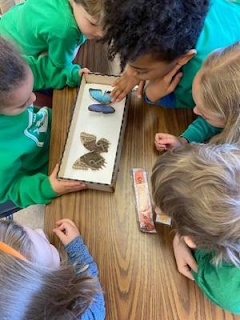
                                       Students examining a butterfly box from Friends of the Rainforest. (Provided)

Kisela is always working to make the nonprofit’s education programming more accessible. During the pandemic, one of the larger educational programs she developed was Friends’ take-home butterfly mounting kit, which was offered through a partnership with the Sophia M. Sachs Butterfly House in Chesterfield.

On Friday, April 22, Friends of the Rainforest will furnish several virtual videos live from Costa Rica. These Earth Day lessons will be led by Lindsay Stallcup, one of the organization’s executive directors, who currently resides in Monteverde.

Locally, this year’s Earth Day celebration will encompass the entire weekend. The international theme is “Invest in Our Planet.” Friends of the Rainforest will have a booth set up on April 23 and 24 at the Earth Day 365 festival, which will be held from 11 a.m.-5 p.m. near the Muny in Forest Park.

The nonprofit will also be at the Sophia M. Sachs Butterfly House for the entire week leading up to Earth Day, celebrating Environmental Education Week. Additionally, kids and families can sign up online for Pollinator Fair Days to be held on April 23 and 24 from 10 a.m.-4 p.m. at the Butterfly House in Faust Park.


Sunday, March 27, 2022

No Leash Needed is deemed right fit for long-vacant Ellisville location

Just as a certain dog may be a perfect match for its master, a specific commercial location could be likewise for a certain business. That’s pretty much why No Leash Needed will soon move into its new location at 15599 Manchester Road.


At the March 16 Ellisville City Council meeting, National Veterinary Associates, Inc. (NVA) was unanimously granted a conditional use permit for No Leash Needed. The business will operate a combination pet day care, pet training and boarding kennel facility. Unlike other No Leash Needed locations, the Ellisville one will not be providing veterinary care.

The site was not an easy one to fill as Bill Barnes, commercial real estate broker with NAI DESCO, explained.
“I was hired by the property owner, Mr. Denny Boyd (of the Bedroom Store), to list the property for lease,” Barnes said, noting that he listed the property in April 2019 and it was previously listed by another company. The property is just under 12,000 square feet. 

“It’s well located but it’s been challenging to find a tenant,” Barnes said. “A couple reasons why: Once you get above 4,000 to 6000 square feet, your prospect list goes down quite a bit. Second, the property is not anchored by a traffic generator such as a grocery store, a Costco or Walmart. I’ve been a retail broker for 16 years and when we cold called trying to find retailers to locate at the property, they were very interested in the location and being in Ellisville, but they really want to be in an anchored center. So, we’ve had none that really fit the bill.”

The future site of No Leash Needed in Ellisville (Source: Loopnet.com)

Now, however, NVA is going to invest between $1.6 and $1.7 million in the Ellisville building.

“One thing about NVA that a lot of people don’t know is they’re probably one of the largest veterinary clinics that practices in the country,” Barnes said. “They’re a really established company with the resources to run a really solid business.”    

Answering questions from council member Vince McGrath (District 1), Shad Cloud, of NVA, said the site will furnish up to 66 boarding kennels. There will be anywhere from 60 to 120 dogs on the site for day care. An existing wooden fence will be replaced by a new one and trees in the area will remain as a buffer and extra sound barrier for neighbors to the north in compliance with recommendations of the landscaping plan. Those sound barriers will be for times a handful of dogs are outside.

“The dogs will not be able to go in and out by themselves,” Cloud said. “That would be controlled by the staff. There’s one or two staff members with the dogs at all times.” 

Small groups of dogs are normally rotated in and out and divided by breed size. The facility will have several indoor yards, which helps to manage outdoor yard use.

The last staff person leaves around 10:30 or 11 p.m. and the earliest returns around 6 a.m., Cloud said. However, the dogs are typically inside so any sound would be muted in the case that one or several are howling. Open hours are 7 a.m.-7 p.m. so the last time you’ll see a dog outside would be between 7:30 and 8 p.m.; anything that happens after that would be in one of the indoor yards.

Cloud also noted that both animals and humans are evaluated and well trained. 

“We focus a lot of energy of on the evaluation of dogs to make sure we’re bringing in ones that work well with the population we have,” he said. “We have dogs coming in that can be controlled and can be in that environment. But we also do a lot of training with our staff, and we focus our energy on dog control. So, you don’t hear the amount of barking as you do at a franchise type location or a dog resort because staff members are always there and they’re well trained to control dogs. We want to be friendly and courteous neighbors to everyone.”

Bill 3740 passed unanimously to become Ordinance 3509 after an amendment from council member Dan Duffy (District 3) to amend the petition such that dog waste runoff be handled by best practices as defined by City Administrator Bill Schwer. Solid waste will be collected at all times and disposed of at the end of every day.